IEC 60038 New Voltage Systems
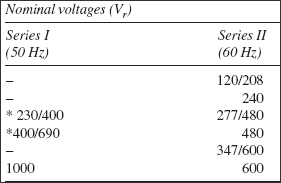
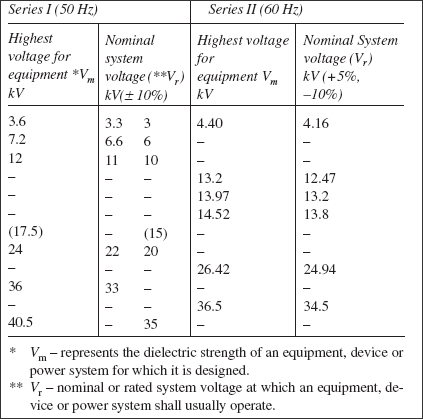
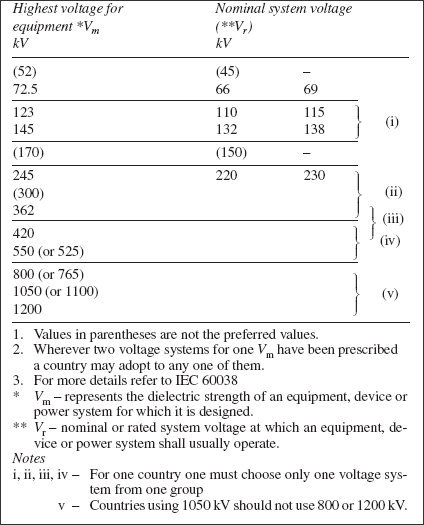
In pursuit of bringing more uniformity in voltage systems and promoting international understanding and business amongst various countries, IEC in consultation with experts of many countries has made an attempt to club dissimilar voltages practised by different countries into just a few slabs to narrow down this disparity for the advantage of all. The new voltage systems are noted in the Table I-1 for LV and Tables I-2 and I-3 for HV and EHV systems. These voltage systems are to be followed by all member countries who follow international practices in design and manufacture of their products to facilitate better understanding and business relations with other countries. With a view to making transition easier, higher voltage variations (as noted in the tables) are now prescribed for all new equipment and devices manufactured as per the new voltages to facilitate easy retrofitting of the old equipment and devices with the new ones without calling for two designs to meet the situation.
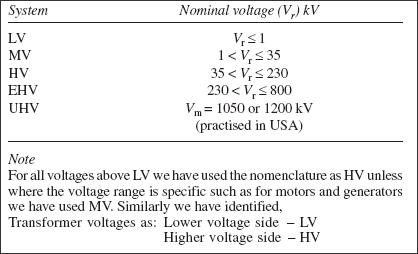
All countries following international Standards were required to follow the revised voltage systems by 2003. But many of them have not been able to do so as yet, because of practical problems. Although the maximum change is only in LV voltages, it too demands for change in design and change of existing equipment and devices besides the change of supply voltage in the existing distribution networks and all that is not an easy task. Nevertheless most countries are endeavouring to fall in line sooner or later. We have therefore retained our earlier tables. They will stand modified in proportion to the change in voltages. For exact details, one may refer to the relevant Standards. To identify the voltage level, the nomenclatures used by us are shown in Table I-4.
|
Table I-1 IEC 60038 New voltage systems |
Table I-2 Series I or II (50 Hz or 60Hz) |
|
|
|
|
* The manufacturers and users shall endeavour to change
over by 2003 from the existing 220/380 V and 240/415 V systems to the
new voltage system of 230/400 V (+6%, -10%) or (+10%, -6%) respectively.
The first step shall be taken by the electricity supply authorities
of a country to adjust their voltages to the revised level to be followed
suit by the manufacturers and users of equipment and devices.
|
|
Table I-3 Series I or II (50 Hz or 60 Hz) |
Table I-4 Nomenclatures used to represent different voltage levels |
 |
|